|
Snaking
along the lumbering River Kapawi, buzzing from thickly-clad
bank to wooly bank, a hoatzin bird puts on a display for the
newly-arrived tourists. From its low-hanging branches, it
rears up on its hind legs and flaps its brown and yellow wings,
screeching and hissing. As we motor past, it turns, as if
to make sure we've acknowledged its presence. It is a fitting
welcome to the Kapawi Ecolodge: the hoatzin, also known as
the 'stinky turkey', is the lodge's symbol, adorning all the
staff's T-shirts and the lodge's literature.
Kapawi
lies in southeastern Ecuador, close to its border with Perú.
It's a long way from anywhere. To get to the nearest airstrip,
you fly in a small jet from Quito for an hour, transferring
to an even smaller plane for a further 45 minutes. From there,
it's another 40 minutes by motorised canoe.
Kapawi
stands at the bleeding-edge of green-building tourism. The
20 cabins and social structures are built in traditional Achuar
Indian style; solar energy provides around 65% of the lodge's
power; all solid waste is recycled or flown out; cleaner four-strokes
are employed as outboard engines; all sewage is laboriously
filtered; hot water comes from five-gallon bags left out in
the sun - the list goes on.
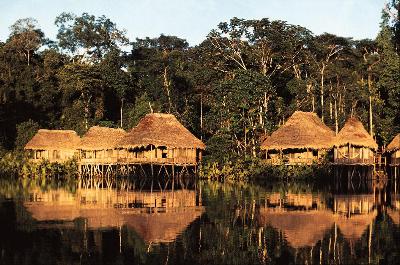
The
beautiful thatched and cool cabins girdle one side of a small
lagoon, walkways interconnecting the various parts of the
lodge. Wooden pegs pin floorboards and walls, and twine binds
the functional yet elegant roofs. The decoration in the social
longhouse is Spartan yet stylish, halogen lights on rails
running between beams, hammocks and chaises-longues overlooking
the tranquil lagoon, table games sculpted from vegetable ivory
dotted about on coffee tables that look like ant-eaters. Incredibly,
there's nary a nail in the whole place. But Kapawi, admittedly
a laudable low-impact tourist lodge with a stunning jungle
setting, is much more than that.
VISION OF THE FUTURE
 At
a time when concerns regarding the equitable relationship
between tourism operations and indigenous people are greater
than ever, Kapawi offers a vision of co-operation and understanding.
The lodge lies in the heart of Achuar territory, an Indian
people of the larger Jívaro linguistic group. Jívaro land
is the size of Portugal. Belgium would fit snuggly into the
Achuar's share alone, although its 4,500 inhabitants would
make little impact on the population of a Brussels suburb.
The Achuar's back yard is one of the few parts of Ecuador's
slice of the Amazon to have escaped, thus far, the depravations
of oil exploration, mining and logging. With no roads for
hundreds of miles, the forest is primary, pristine. At
a time when concerns regarding the equitable relationship
between tourism operations and indigenous people are greater
than ever, Kapawi offers a vision of co-operation and understanding.
The lodge lies in the heart of Achuar territory, an Indian
people of the larger Jívaro linguistic group. Jívaro land
is the size of Portugal. Belgium would fit snuggly into the
Achuar's share alone, although its 4,500 inhabitants would
make little impact on the population of a Brussels suburb.
The Achuar's back yard is one of the few parts of Ecuador's
slice of the Amazon to have escaped, thus far, the depravations
of oil exploration, mining and logging. With no roads for
hundreds of miles, the forest is primary, pristine.
Under
the agreement drawn up by the company which took on the Kapawi
project, Canodros, the entire tourist infrastructure will
be handed over to the Achuar in 2011. Canodros never bought
the land, but agreed to lease it. They pay a monthly rent,
which increases by 7% a year and currently stands at nearly
$3,000. In addition, each tourist pays a $10 community fee.
Fees are expected to have totalled $150,000 over the project's
15-year course. By 2011, Canodros will have trained the local
Achuar communities in all aspects of the running of the lodge,
from manager down to barman. Even now, around 60% of the staff
are indigenous, with outsiders only holding posts until they've
trained their protégés. Only a handful of lodges in the world
run on this basis.
UNENVIABLE REPUTATIONS
 Although
very few people had actually met them, the reputation of the
Jívaros and particularly the Achuar preceded them. Fierce
fighters and defenders of their lands, the Jívaro were known
chiefly for their predilection for shrinking their enemies'
heads. These grisly totems were occasional bartered, and found
their way to the markets of Ecuador's highlands, and even
as far as traders on the Panama Canal. Although
very few people had actually met them, the reputation of the
Jívaros and particularly the Achuar preceded them. Fierce
fighters and defenders of their lands, the Jívaro were known
chiefly for their predilection for shrinking their enemies'
heads. These grisly totems were occasional bartered, and found
their way to the markets of Ecuador's highlands, and even
as far as traders on the Panama Canal.
In the late nineteenth
century, the Dominican Abbé Pierre provided one of the first
accounts of these "ferocious savages entirely devoted to the
pleasures of warfare and the works of Satan." When the tour
guide and adventurer Daniel Coopermans paddled his way down
the River Kapawi in the late 1980s, the Achuar were still
among the least known of Ecuador's Amazonian tribes. Only
in the 1960s had Salesian missionaries managed to penetrate
their lands successfully, and begun to pacify them. In the
1970s, the French anthropologist and pupil of Claude Lévi-Strauss,
Philippe Descola, spent many months with them. His experiences
are recounted in his excellent The Spears of Twilight (1996).
Daniel
and his friends were looking for the best location for a jungle
lodge. One day, they came round a bend in the river, and entered
a beautiful, secluded lagoon on its left bank. The place proved
ideal. There's a subterranean well nearby for drinking water,
with the mission and airstrip of Kapawi only an hour's paddle
away. All perfectly straightforward, if a bit eccentrically
remote. No matter how good the intentions, however, the cultural,
economic and spiritual impacts of Kapawi on the Achuar were
going to be inevitable. As Lévi-Strauss, whose work with Amazonian
Indians is still regarded as seminal, himself has pointed
out "The people for whom the term cultural relativism was
invented, have rejected it."
Ecuador
enjoys the grim fame of the Amazon Basin's highest rate of
deforestation. The Achuar only need to look to the north to
see their fellow indigenous cousins being wiped out by the
environmentally-catastrophic oil industry. Faced with the
prospect of the oil industry eventually working its way south,
with new roads inevitably drawing ill-prepared colonists,
the Achuar chose the lesser of two evils. Huge effort has
gone into channelling change towards this once-feared people's
survival. The ultimate goal of Kapawi is to prove the tourism
industry can be a viable and competitive - not to mention
un-destructive - force to protect this untouched piece of
rainforest and its people.
THE FOREST COMES ALIVE
Spending
time with the Achuar, you realise how inseparable the latter
two truly are.
"The big trees of the forest are very powerful,"
claims my Achuar guide Gilberto, standing in the shadow of
a mammoth ceiba tree. "All plants and trees are people, but
you can't see them normally. The tall ceiba earns great respect,
but is also dangerous for newly-born children. It whispers
to them and makes them ill. When you take the hallucinogens
naatam (commonly called ayahuasca, Banisteriopsis caapi) or
wanto, the forest comes alive."
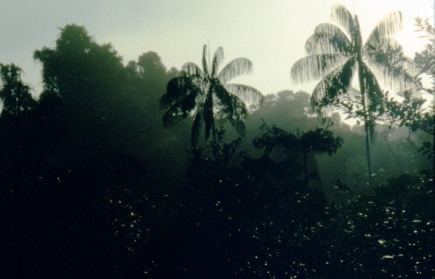
Walking
through the forest with Gilberto, the green and brown morass
of decay and destruction, in turn, springs to life. Gilberto's
encyclopaedic knowledge, of plants, flowers, animals, myths
and customs, is enough hallucinogen for most people. After
an hour on a trail, the putative impenetrable mass of life
and death instead becomes a forest of revelation.
"The
shishin speaks kind words while you are in a hallucinogenic
trance," he explained pointing to an arrow-leafed plant carpeting
the forest floor. "It is very friendly. The shamans brush
it over the body of a patient, chasing bad spirits." Another
plant, chirikiaspi, gives the hunter strength and fortifies
the lungs to be able to shoot monkeys high in the canopy with
a blow pipe. It also anaesthetises the body, making you feel
numb and able to walk for days without much food. No bad thing
when you've got to trek the equivalent of Brussels-Antwerp
to visit your granny.
 Gilberto
had taken the hallucinogen wanto twice. When he talked about
it, his dark eyes glowed, and his usually nervous smile and
laugh came more readily. Although the missionaries have done
their best to banish the Achuar's animist beliefs, shamans
and the use of the forest's hallucinogens, they are still
integral to the older generation of Achuar. Gilberto claimed
that after taking wanto he was left raring to work and hunt
and spend more time in the forest. In the Amazon they're banning
it. In New York they'd kill for it! Gilberto
had taken the hallucinogen wanto twice. When he talked about
it, his dark eyes glowed, and his usually nervous smile and
laugh came more readily. Although the missionaries have done
their best to banish the Achuar's animist beliefs, shamans
and the use of the forest's hallucinogens, they are still
integral to the older generation of Achuar. Gilberto claimed
that after taking wanto he was left raring to work and hunt
and spend more time in the forest. In the Amazon they're banning
it. In New York they'd kill for it!
Just
as these drugs are woven into their daily life, their oneiric
world decides most of the next day's waking activities. The
Achuar extract symbolic meanings from their dreams. If a man
dreams of fighting with his brother and drawing blood, it
in fact means that if he goes hunting he'll come across a
herd of grunting peccary.
AMAZON MENAGERIE
We
didn't happen across any of these scary boar-like creatures
that terrorise forest paths, nor any jaguars or large mammals-
despite Kapawi ranking among the best lodges to see such beasts.
We found the tracks of a young ocelot, spotted troops of howler
monkeys and gaggles of toucans, and early one morning, observed
a mother caiman crocodile only slightly longer than my notebook
herd her twelve mewling offspring around the shores of a lagoon.
On a visit to a local family, we were introduced to their
pet anaconda, kinkajou and cute coati.
At
dawn on another morning, we took a launch to a saladero, clay lick . Here,
flocks of iridescent parakeets, parrots and macaws come to
gnaw on clay banks. The clay aids their digestion, but the
morning ritual also serves as a mating ground. The young birds
come to meet their partners here, squawking and flapping and
swooping their way to life-long married bliss. In this respect,
the saladero is not dissimilar to the youth club discos I
attended in my teens. Just without the finale bent over a toilet.
On
the morning of our departure, the hoatzin was there to flap
us goodbye. We weren't sure if it was the same one. But having
read up about the bird, it seemed more appropriate than ever
that it should guard the entrance to this remote and intriguing
lodge.
The
baby hoatzin is the only bird to boast a set of claws on its
wings. If it falls out of the nest, it employs them to clamber
back up to its parents' perch. The Achuar are, to my mind,
the young hoatzin, acquiring the tricks of the tourist trade,
and developing the skills to deal with the outside world on
their own terms, under the tutelage of the people at Canodros.
In the fifteen years of the Kapawi project, the Achuar will
have gone from flailing about on the ground, through learning
to haul themselves up on their own, to finally greeting their
guests with their very own display. Just don't call them stinky
turkeys.
Kapawi
Ecolodge & Reserve TEL (022) 256759 or 445639 email
eco-tourism1@canodros.com
web site www.kapawi.com
Pachamama
Alliance: Works with the Achuar on various community
programs, and also organises special tours to the lodge.
|